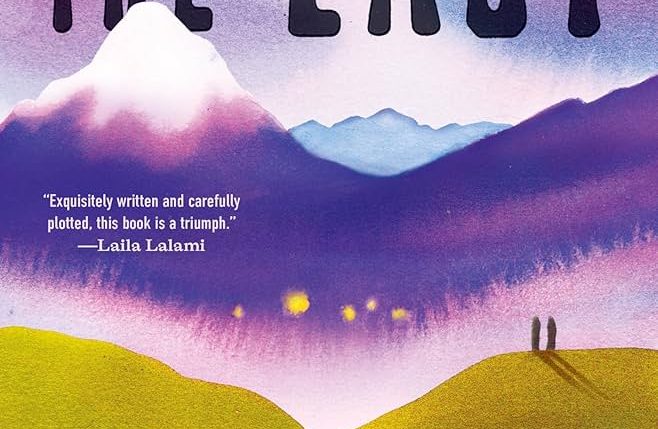
Book review: The Last days of Earth by Deepa Anappara
To map a sacred land
The ethics of map-making and the invisibilisation of those who helped the British Empire in doing so, is at the heart of Deepa Anappara’s second book of fiction. Coming many years after Djinn Patrol on the Purple Line, her first, well- received one, this book too, is meticulously researched and beautifully written.
The story unfolds in two ways—one, as a carefully plotted adventure in which two sets of people with different motivations journey illicitly across Tibet. The other, as a quiet meditation on many issues existential and otherwise.
The year is 1869. Tibet is closed to the Western world and this casts a spoke in the wheel of the British Empire’s ambitions to map it and expand the empire. To get around this, they start to train Indians as surveyors so that they can enter Tibet illicitly and map it.
Two groups are making parallel journeys across Tibet, and this is chronicled in alternating chapters. They will meet at the end, changed by their circumstances and experiences. In one we have an Englishman, simply called the Captain throughout, and his second -in – command Balram, an Indian schoolteacher trained as a surveyor, and one who has taken many such undercover trips into Tibet for the British. They are accompanied by a vast retinue of bearers, animals and stores needed for the long journey.
The captain wishes to chart the course of the Tsangpo river and discover where it meets the sea. He is poorly disguised as a monk and there is the ever present danger that if he is exposed as a white man, it will mean death not just for him but for his companions, too. This does not deter him. As Balram’s father says ‘It’s in the nature of white men to believe they own the world, that no door should be shut to them.’
Balram has come on this perilous mission for reasons of his own. He wants to find his friend who has gone missing while doing a surveying job for the British.
The other two people making the same journey is a British woman Katherine who is part Indian, which makes her disguise as an Indian pilgrim more authentic. She wants to be the first European woman to visit Lhasa, having been thwarted twice in doing so. Denied a fellowship in the all-male Royal Geographical Society in London, she sees this opportunity as a means to make a mark and gain entry. She is accompanied by a wise manservant who wishes to become a monk soon.
Conflicted lives
All of the three main characters – the captain, Balram and Katherine — are conflicted and share a restlessness of mind. They are happy travelling and away from home, however dangerous the journey. The captain feels bitter at the fact that his early promise seems to have dissipated and hopes the maps he will now make bring him fame and immortality. He states grandiosely, ‘Our little drawings will one day reshape the world.’ Katherine’s dubious antecedents and her experiences back home render her as the eternal outsider; on this trip, she carries the memory of her deceased sister. Her travel then, is a way of escaping from herself.
It is the same for Balram. He is wracked by guilt and conflicting emotions. All of this stems from his relationship with his missing friend and his differently abled son. The nature of that friendship borders on the illicit, though both don’t act on it. At the same time, he feels intensely competitive as his friend is considered the better surveyor by the captain. The journey will offer both Balram and Katherine space to introspect on their life and past behaviour.
Through both the white protagonists, the story examines their obsessive ambitions in attaining their goals, never mind the cost it extracts. The help and support of the Indians who accompanied them is critical to them. And yet as the book points out, no mountain or place is named after them; it is the white man who gets the glory and the immortality; the native is simply erased.
The Buddhist idea of the impermanence of life is threaded significantly though the book. All that the travellers face during their journey – floods, extreme weather, bandits, snow lions — can mean a loss of life at any instant. Maps can be rendered incoherent ‘if the earth shrugged, mountains would cleave, rivers would surge, seas would swallow cities and fields alike.’
The landscape of Tibet is also a dominant character throughout. It is described in a detailed lyrical way on almost every other page, to makes the reader pause to soak it in, and soon get so immersed that they become a co- traveller on the journey.
This sublime, immersive, gripping book moves you even as it makes you think.
The Last of Earth by Deepa Anappara. Penguin Books. 371 pages. 899 rupees
This ran in Deccan Herald of 15 March 2026.
Related Links:
Book review: Djinn Patrol on the Purple Line by Deepa Anappara
 Sheila Kumar • March 15, 2026