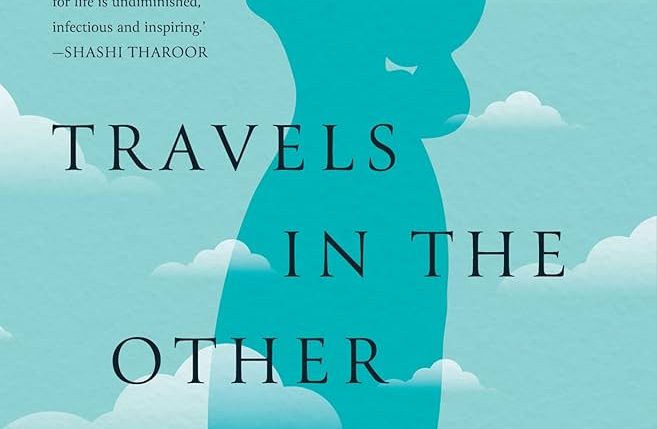
Book review: Travels in the Other Place by Pallavi Aiyar
There`s travel and then there`s travel….
Pallavi Aiyar`s book has no ambiguity about the subject at hand. A neat meld of memoir and travelogue, she takes us aboard her personal train, opens the compartment doors to us, tells us of trips into the land of Books, into the barren wastes of Illness, shows us how Language is a unifying force in the end, rues that Pedagogy contains traps into which all of us fall, shares that her Indian passport continues to be a ball and chain, in the Reporting chapter, gives us insight into politico-social accounts she`s filed from across the world, and circles back to travels in the `other place,` a place containing both significant loss of Hair and bottomless wells of Grief.
Life, the author avers, is a collage of temporal journeys. All you need to be equipped with cognitive empathy. And then, she goes on to show just how this philosophy has held her in good stead in her sojourns.
Here and there scattered through the book are small homilies that glitter as the eye catches them. Her experience is that the more points of reference collected, the more relative the experience of travel inevitably becomes. She points out that despite the metaphorical association with access, like when we use the phrase `a passport to a better life`, a passport is actually about restriction. She rues the fact Indian reporters are a meagre presence in the wider world. And then she shows us how her western colleagues look a story very differently from the way she absorbs it, through the prism of her Indian identity. Travelling is as much about the places you visit as it is about the place you have left behind, the author avers, and as you read the book, you fully understand what she means.
An open book
By the end of the book, Pallavi Aiyar is, pardon the cliché, an open book. We have watched her grow up amongst books in Delhi, we have watched her growing closer and closer to her mother, (`she is my rites and my roots`) specially after her parents` divorce. We cheer her nascent writing of articles and wince at the fact that decades on, her `salient points` still remain pertinent. We watch as she goes off to the UK to study, how she meets a Spaniard, falls in love and marries him, and has two sons with him. We watch with hope in our hearts as she battles cancer bravely, taking us along every step of that journey too (`my comfort level with being public about illness was high`). We smile as she confesses that a good haircut actually has her feeling she is back from that other place— of illness. And we root for her hopefully sunlit future, as her family and she move peripatetically around the world every few years.
There`s travel and then there`s travel….
Pallavi Aiyar`s book has no ambiguity about the subject at hand. A neat meld of memoir and travelogue, she takes us aboard her personal train, opens the compartment doors to us, tells us of trips into the land of Books, into the barren wastes of Illness, shows us how Language is a unifying force in the end, rues that Pedagogy contains traps into which all of us fall, shares that her Indian passport continues to be a ball and chain, in the Reporting chapter, gives us insight into politico-social accounts she`s filed from across the world, and circles back to travels in the `other place,` a place containing both significant loss of Hair and bottomless wells of Grief.
Life, the author avers, is a collage of temporal journeys. All you need to be equipped with cognitive empathy. And then, she goes on to show just how this philosophy has held her in good stead in her sojourns.
Here and there scattered through the book are small homilies that glitter as the eye catches them. Her experience is that the more points of reference collected, the more relative the experience of travel inevitably becomes. She points out that despite the metaphorical association with access, like when we use the phrase `a passport to a better life`, a passport is actually about restriction. She rues the fact Indian reporters are a meagre presence in the wider world. And then she shows us how her western colleagues look a story very differently from the way she absorbs it, through the prism of her Indian identity. Travelling is as much about the places you visit as it is about the place you have left behind, the author avers, and as you read the book, you fully understand what she means.
By the end of the book, Pallavi Aiyar is, pardon the cliché, an open book. We have watched her grow up amongst books in Delhi, we have watched her growing closer and closer to her mother, (`she is my rites and my roots`) specially after her parents` divorce. We cheer her nascent writing of articles and wince at the fact that decades on, her `salient points` still remain pertinent. We watch as she goes off to the UK to study, how she meets a Spaniard, falls in love and marries him, and has two sons with him. We watch with hope in our hearts as she battles cancer bravely, taking us along every step of that journey too (`my comfort level with being public about illness was high`). We smile as she confesses that a good haircut actually has her feeling she is back from that other place— of illness. And we root for her hopefully sunlit future, as her family and she move peripatetically around the world every few years.
Written with her trademark wry humour and immense charm, Aiyar offers readers a piquant opportunity to travel in this place, that place and the other place with her.
Travels in the Other Place
By Pallavi Aiyer
Tranquebar Books
193 pages
Rs 599
Travels in the Other Place by Pallavi Aiyer. Tranquebar Books.193 pages.Rs 599.
This appeared in TNIE`s Sunday Express magazine of 1 March 2026.
Related Links:
Book review: Orienting, an Indian in japan by Pallavi Aiyar
Book review: Jakarta Tails by Pallavi Aiyar
Book review: Chinese Whiskers by Pallavi Aiyar
Book excerpt: Smoke and Mirrors, an Experience of China by Pallavi Aiyar
Book review: Punjabi Parmesan by Pallavi Aiyar
 Sheila Kumar • March 1, 2026