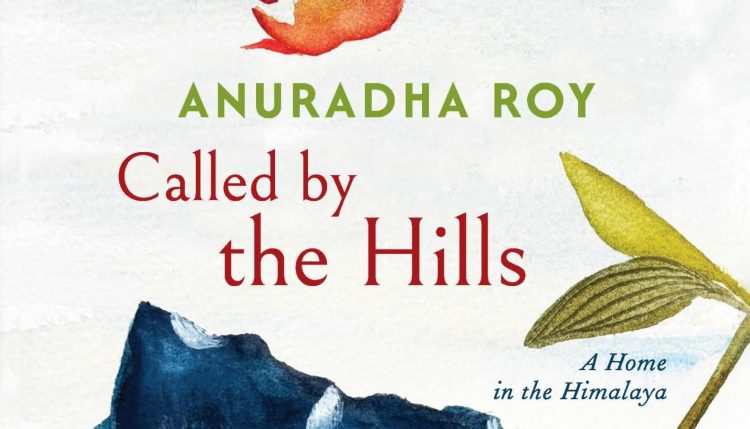
Book review: Called by the Hills by Anuradha Roy
Over hill and dale
First, it`s a memoir that takes us on a leisurely wander through the forests and dirt tracks of Ranikhet, where the author has lived for a quarter of a century now. Second, it has the most luscious illustrations ever, all done by the author, giving us a clear picture of just what she is talking about. And third, there`s a surprise bonus, six postcards tucked away in a sleeve on the inside of the back cover, which we will happily pore over, again and again.
The dedication is to a beloved dog Jerry who was picked up a by a leopard literally in front of Roy`s eyes. The horror, the dismay, the sense of loss is all gently touched upon even as the grief comes through loud and clear.
There is a quote from the Chinese author Li Bai (Li Po) that ends like this…
We sit together, the mountain and me,
Until only the mountain remains.
Roy tells us she and her partner who is referred to as R through the book, live in what was the cowshed of a sprawling estate. Some amount of renovation later, it became their home as well as the site of their publishing concern. `R and I run a small publishing house,` she states dryly, `that is, we publish books from our small house. `
Using a light, chatty tone, disarming us with her no-frills style of narration, Roy takes us through her lived experiences, joys and sorrows, of living in the hills. The first glimpse of snow- clad mountains from the windows of their cottage, shining white and blue, five times bigger than the hills at their base; the exact bend in the road where the air turns to champagne. The process of dissuading scorpions and snakes in their quest for rent-free accommodation in the cottage; the art of keeping leopards at bay, which involves talking loudly, groaning, singing, coughing, carrying a torch. Connectivity problems when the bytes `can`t climb the mountains;` renovations talking forever because the roads have been washed away by rain, or because of a melancholic buffalo delaying the plumber.
Sophar-Sogud
The area around (the cottage) fell into a forest of pine, oak and rhododendron, where the ground was covered with ferns and wildflowers. Roy wanted to carve a small garden from the wilderness, and really put her back into it, learning to handle manure, soil, seeds. You need to feel things with your fingers: real maalis never wear gloves, she points out.
We meet the Ancient, a doughty old woman who seems to have come with the cottage they now own, whose husband, better travelled than her, when asked whether he liked living in Raniket, would say, `Personally I prefer Antwerp.` We meet Mr Singh, Director of the government orchard and adopt his addictive refrain, sophar-sogud. We meet all their dogs, from Barauni Junction and Biscoot to Jerry. We meet the man on the train who describes how his 200- year- old Tehri town went under water when a giant dam came up to supply electricity to the plains. We meet Sundar and his wife who point out direct evidence of climate change and global warming, with the author adding that temperatures last year touched 40 degrees in some parts of the mountains.
Then we meet the various birds that flit in and out of her garden. The whistling thrush, the barbets, sparrows, magpies, woodpeckers, tits, blackbrids.
It`s not altogether a rosy picture though; Roy tells us of the severe drought-like conditions, the gardens drying up for lack of water, the flowers wilting and withering, the townswomen (yes, it`s always the women) standing in line to fill up buckets when the corporation water comes through. The monsoons too are deconstructed for us: a time the sky cracks like an eggshell as lightning strikes, trees fall, chunks of hillsides crumble, giant boulders plummet onto roads from slopes above. Sophar-sobad, in other words.
Roy talks of how she feels a bit disoriented when she has to go down to the plains when a new book of hers is out. `I hide in a different wardrobe and personality at such times….and return with infinite relief to the silence of the forests and mountains and the people who do not read,` she says with an air of finality.
For all the Miss Read charm that underpins the book, what comes through is that this kind of enforced solitude is not for everyone; it is the life she and R have chosen, though, and they thrive in it. There is a pertinent quote from writer/historian/activist Shekhar Pathak that the mountains cannot be treated as the prerogative of any one community, religions or belief. …it is a unique example of the unity of humankind. Indeed, a credo we would be wise to hold onto.
Called by the Hills: A Home in the Himalaya by Anuradha Roy. John Murray/Hachette India. Rs 999. 171 pages.
https://www.deccanherald.com/features/books/called-by-the-hills-book-learning-to-listen-3856413
This ran in the Deccan Herald of 11 January 2026.
Related Links:
Book review: The Earthspinner by Anuradha Roy
 Sheila Kumar • January 11, 2026