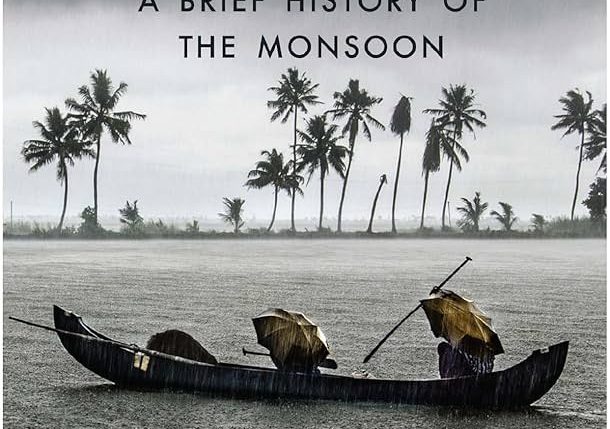
Book review: The Fragrance of Rain by Stephen Alter
Monsoon magicking
This is Stephen Alter chasing the monsoon, taking us along with him. He adopts a freewheeling approach, first walking us through the pre-monsoon winds in the Doon Valley where he lives. The pictures he draws are sharp, verging on violent: `…as the storm closed in on the mountains, I could feel the energy and tension in the air. The wind grew stronger and rougher, buffeting the deodar trees overhead while the imminent dawn retreated back into darkness. A flash of lightening to the east was followed almost immediately by a blast of thunder. Moments later, another lightning bolt tore through the gloom and struck a ridge below. The detonation shook the ground …as hailstones the size of chickpeas began to pelt the flower beds…we were inside a maelstrom as churning clouds washed over the mountains like an airborne tsunami.’
We then travel to Kochi where Alter hopes to catch `cloud banks massing offshore before they ploughed inland like an armada of moisture.` And as we walk around Kochi, we look at several things when we aren’t looking up at the skies, like the cannon at Fort Emmanuel, the young men in white tees plogging, a fish auction, as well as a quick peep into the Naval Maritime Museum. No rains hit Kochi when we are there, though, so off we go, the reader and the writer, to Munnar, where we trek in the Eravikulam National Park keeping a sharp lookout for the Nilgiri tahr and if we were lucky to be in the blooming year, the fabled kurinji plant.
Since the rains continues to play truant, Alter then takes us to Goa, where he lives part of the year. Here he links the monsoon to a homecoming by travellers, when they return home before the seas grew too rough for safe passage, roads were mired in mud, bridges and embankments were washed away, towns and villages marooned.
The vitality of the rains
Just as the monsoon seems to pause, so do the author and reader. In this pause, we learn of the origins of the monsoon according to Vedic mythology as the titanic conflict between Indra and the demon Vritrasura. We read that astrologers trace the arrival of the monsoon as coinciding with the sun`s passage through the Mrigashira (deer`s head) constellation. We see that Teej, Naga Panchami, Ganesh Chaturthi, all religious events tied to the climate, venerate water as an essential element of life.
This being Stephen Alter, we read of the many species that evolved driven by the cycle of annual rains. We learn that the once regular orchestra of frogs during the rains in Goa have now fallen silent, fallen prey to over built-up towns. Then we go herping in the rains, to look closely at varied snakes including the rare caecilian, as well as frogs , owls, and some bioluminescent fungi.
For all the lyrical tilt of the title, this is not really a romantic look at India’s monsoons. Rather, it is a keen look at the elemental force, the creatures that emerge with the rains, the disasters that inevitably take place. Any romantic reference to the rains is made in oblique fashion, as when we are told of the sweet, slightly musky odour that fills the air after a storm, fresh yet with a hint of decomposing leaves and carrying a sensual alluring perfume.
The Fragrance of Rain: A Brief History of the Monsoon. By Stephen Alter. Aleph Books/Essential India Editions. 140 pages.Rs 499.
This ran in TNIE of 9 August 2026.
Related Links:
Book review: What the Rains Foretold by N. Mohanan
https://www.sheilakumar.in/2022/10/book-review-the-greatest-enemy-of-rain-by-manu-bhattathiri/
 Sheila Kumar • August 10, 2026