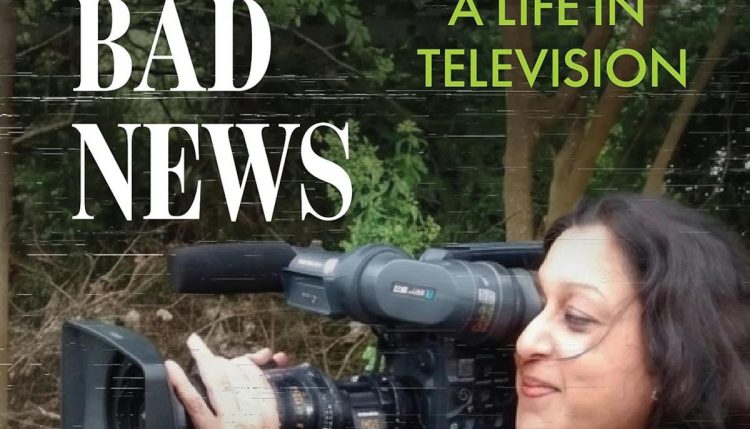
Good News, Bad News: A Life in Television by Maya Sharma
A life in Indian television news
It is but inevitable that the reader would approach veteran television newsperson Maya Sharma`s memoir with some amount of expectation. And the author doesn’t disappoint; her recollections are a gentle flow, in much the manner she employed on the small screen, the manner of speaking directly to the viewer there, to the reader here, in a warm, chatty tone.
That conversational tone stays intact all through, as she starts unspooling her personal growth story, juxtaposing it with the evolution of television broadcasting. She tracks her 1980s journey with first the State-owned Doordarshan, then at the private channel NDTV newly set up by Dr Prannoy Roy and his wife Radhika Roy, and concludes with a succinct summing up of the buyout of NDTV by the Adani Group, and its political fallout. While Sharma makes no effort to conceal her respect and affection for the Roys, she documents the changes wrought in the country by private channels in a frank but fair fashion.
An old hand with over thirty years in Indian television news, one who grew along with TV news in India, this Fulbright Scholar and Karnataka Rajyotsava Award-winner is most qualified to chronicle the changes in Indian TV; the bonus is that her account is an easy read, peppered with doses of both sarcasm and wit.
A wide canvas
It wasn’t a straight path to television. After her Mass Communications course, Sharma did stints in Wipro, TOI, BPL, then went on to Doordarshan, won a Fulbright Fellowship at Syracuse University in New York state, was part of the Bangalore team who pitched for and got approval for a weekly news magazine called Insight, after which she moved to NDTV, a channel which, she states, changed the face of TV news in India with its professional approach to production and its liberal world view editorial stance.
Sharma makes it clear she belongs to the old school of journalism where the reporter was not the story, where the story itself was well-researched and well-written before it aired, and most important, was backed up with facts not surmise- or agenda-based, when news was announced, not broken, when professionalism ruled the roost.
It`s a wide canvas that includes covert sexism in the workplace, how regional news was subtly and then, not too subtly sidelined for Delhi-based news, how the south segments would get shorter and shorter, how she got access to most politicians in Karnataka having become a familiar face, how the government eventually stopped giving ads as well as speaking to NDTV, thus putting a mega squeeze on it.
The language is simple, free of frills. The irony is unmissable, as when Sharma states that back in the day, Doordarshan was not a place where reporters spoke truth to power, how they were expected to faithfully highlight in a positive way the activities of the authorities of the day; the reader reflects wryly how it has all circled back in present times.
Maya Sharma`s book may be a personal memoir interspersed with opinions from her peers and former colleagues at NDTV but there is no doubt that it is a vital addition to documentation about the history of media in India. What this reviewer found remarkable was the complete absence of any bitterness; she rues the demise of a more solid substantial kind of television newscasting but is quick to say that maybe the New India wants the kind of channels that have proliferated now. There is a genuine strain of goodwill all through the account; this then, is a polite memoir/media critique.
Good News, Bad News: A Life in Television by Maya Sharma. Westland Non-fiction. 298 pages. Rs 799
This ran in The Hindu`s Literary Review section of 15 November 2026.
 Sheila Kumar • November 14, 2026