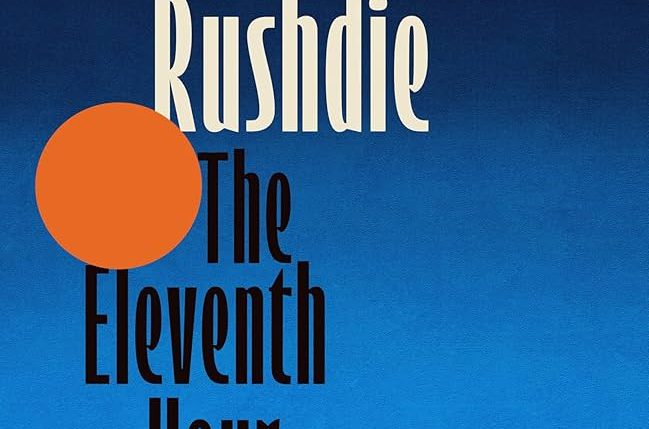
Book review: The Eleventh Hour by Salman Rushdie
Intimations of mortality
After an artful meld of history, imagination and some brilliant writing in `Victory City,` after a show of cold anger in `Knife,` Rushdie is the Elder Statesman or rather, the Elderly Litterateur here. This quintet of stories is quite self-indulgent, with many of the characters being vehicles through which the writer expresses pleasure, displeasure and resignation about the state of things in India, the state of things in the world.
The characters in the first story, two elderly men in Chenni nee Madras, Senior and Junior, are not the most appealing, with their cranky demeanour and hidebound attitudes. It must be remarked that Senior often wore a trilby and carried a silver -handled walking stick when the two would go to the post office to collect their pension cheques. And of course, though they grumbled and griped at each other across their verandas, there was a strong bond between them that is apparent to the reader. When Junior has a fatal accident, we see the immense chasm of loneliness that opens up in front of Senior. `Every morning, he regretted that he had not died in the night.` Thus, the two who were each other`s shadow now became one shadow without a shadow to shadow. The takeaway here? That life and death are just adjacent verandas.
This reviewer`s particular favourite is the second story, that of a discordant musician and a billion-dollar baby, and set in Kahani, the writer`s favourite city Mumbai nee Bombay, because `the city has always been a kind of wonder tale.` A marriage takes place between the two aforementioned people. There is a powerful, interfering mother-in-law, there is an ordinary man who turns into a guru disseminating his Free Sex Theory (FST), gathering followers by the hundreds, acquiring an associate who went by the name of Mommy; the musician`s father runs off to serve in the guru`s soup kitchen. The billion-dollar baby is heir to a powerful corporate giant. The musician’s powers turn sinister, sending the taxmen to hidden lairs in her in-law`s properties. This is Art as Destroyer, and ultimately, total devastation descends upon the conglomerates, as indeed, it would in any story of Good vs Evil.
Then we meet the melancholy ghost of an academic in a hallowed College in England. The don wrote a book that was very well received, but did not write anything after that for thirty-six long years. When asked the reason for his long silence, he said, `I always wrote out of deep unhappiness, and ever since I came to the College I have been happy, so writing has no longer felt necessary.` The ghost befriends a young Indian scholar who can somehow see him. We read of just what the College did to him, thus precipitating his death. And now, it`s time for the ghost to take revenge, which he does most satisfyingly.
After which we meet a missing uncle and a nephew in search of him. Oklahoma features as home, as a place in a musical of the same name, as discovery, a place that blows apart a carefully constructed death, as forgiveness, as revelation.
If that story was dense, the last one is even more dense, but densely fascinating. It involves an Old Man (`old in years as well as sadness`) in a piazza, watching the world go by, watching people quarrel, watching change come stealing upon everything, then the past and its ways reclaim the same people and places. When Language is encroached upon, she sulks and comes to sit in another corner of the piazza. It`s all in a state of flux: Language turns promiscuous, the Old Man gets his five minutes of fame, and finally, words fail them all, possibly Language herself, too. The parable and its allegorical references to free speech are unmissable.
Playing with words
Death casts a light pall on everything. The consummate story-teller that he is, Rushdie is still playing with words, to great effect. We have whimsical pronouncements like `the poor were puritans by night and day; one by one his friends had gone up in flames; there is nothing that unites our people except their love of the quarrel itself, the quarrel understood as a public art form, as the defining heart of our culture.`
He explains cricket to persons from non-cricketing countries thus: `The Test-level countries at that time were India, Pakistan, Bangladesh, Sri Lanka, Australia, New Zealand, South Africa, West Indies, Zimbabwe…. Oh yes, and England. Birthplace of the game. Mustn’t forget old Blighty.` Wicked, what?`
And of course, there are affectionate tributes to Bombay all through the stories set in India. That city which was neither of the north nor of the south but a frontier ville, the greatest, most wondrous, and most dreadful of all such places…the place of in-between.
The Eleventh Hour By Salman Rushdie. Hamish Hamilton/Penguin Random House. 254 pages. Rs 899
https://www.newindianexpress.com/lifestyle/books/2026/Jan/25/intimations-of-mortality-5
This ran in the New Sunday Exress Magazine of 25 January 2026.
Related Links:
Book review: Knife by Salman Rushdie
Book review: Victory City by Salman Rushdie
Book review: Languages of Truth by Salman Rushdie
Book review: Quichotte by Salman Rushdie
Book review: Quichotte by Salman Rushdie
Book review: The Golden House by Salman Rushdie
Book review: Two Years, Eight Months and Twenty-eight Nights by Salman Rushdie
 Sheila Kumar • January 26, 2026